
The rate of price rise for food articles stood at 11.51 per cent during January as against 2.41 per cent a month earlier, while for non-food articles it rose nearly three-fold to 7.8 per cent from 2.32 per cent in December, the data released by the ministry of commerce and industry on Friday showed.

The RBI, which had been following soft monetary policy since September last year to inject liquidity into the system to help industry combat the impact of the global meltdown, on Tuesday reversed its stance by increasing the SLR by one per cent to 25 per cent, though it kept other rates unchanged.

In the case of Indian equities specifically, all eyes will now be on the next RBI monetary policy scheduled for September 29.

RBI's liquidity tightening stance had stumped the Street as a result of which bond yields had risen.

Market breadth depicted gains with 1,476 advances over 1,403 declines on the BSE. 140 stocks remained unchanged.

Markets continued to fall on Monday, with the Sensex declining 94 points as investors remained cautious amid unabated selling by foreign funds and elevated crude oil prices ahead of the RBI's policy decision later this week. The 30-share BSE Sensex declined 93.91 points or 0.17 per cent to end at 55,675.32. During the day, it tanked 473.49 points or 0.84 per cent to 55,295.74.

RBI, in its first bi-monthly monetary policy statement, left the short-term lending rate, or repo rate, unchanged at 8 per cent and the cash reserve ratio static at 4 per cent.

The repo rate, at which the central bank lends short-term money to other banks, will continue to stay at 6 per cent.

From the 30-share blue-chip pack, Adani Ports jumped over 5 per cent. NTPC, Tata Steel, Bajaj Finserv, Zomato, Bajaj Finance, Tata Motors, State Bank of India, IndusInd Bank and Maruti were among the other big gainers. From the 30-share pack, Hindustan Unilever, Titan, Tata Consultancy Services, Infosys and UltraTech Cement were the other laggards.

Reserve Bank of India Governor Shaktikanta Das on Friday said the country's economy is an island of stability despite two Black Swan events and multiple shocks. "In an ocean of high turbulence and uncertainty, Indian economy is an island of macroeconomic and financial stability," Das told reporters during the post policy press conference. He said the financial stability, macroeconomic stability and resilience of growth is being witnessed despite two Black Swan events happening one after the other and multiple shocks.
CRR to remain unchanged at 4.00 pc this fiscal
Headed by Urjit Patel, MPC for the fourth straight time kept the repo rate unchanged, at which it lends to the banks, at 6.25 per cent. The reverse repo, at which RBI borrows, will be 6 per cent.

RBI's latest rate cut will bring down home, car loan's EMI.

Retail inflation eased to a one-year low of 4.75 per cent in May as prices of some kitchen items declined marginally, according to government data released on Wednesday. The Consumer Price Index (CPI) based retail inflation was 4.83 per cent in April 2024 and 4.31 per cent in May 2023 (previous low).

Indian economy is gathering momentum in the second quarter, though inflation would continue to average above the central bank's comfort zone of 6 per cent, said an article in the RBI's monthly bulletin released on Thursday. The consumer price index (CPI) based retail inflation shot up significantly to 7.44 per cent in July, from 4.87 per cent in the preceding month, mainly due to soaring prices of tomato, vegetables and other food items. In his address to the nation on the Independence Day, Prime Minister Narendra Modi vowed to take more steps to contain price rise.

Credible fiscal consolidation has been a consistent pre-condition to easing the monetary policy stance as far as the RBI is concerned.

An immediate RBI rate cut will lower lending rates for banks' MSME/retail/mortgage loans before the 'busy' industrial season ends in March.
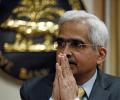
RBI Governor Shaktikanta Das on Tuesday asked private sector banks to ensure continuity in the provision of various financial services, including credit facilities to individuals and businesses, in the face of challenges brought on by the pandemic. Earlier this month, the governor had held a similar meeting with MD and CEOs of public sector banks. During the meeting with the MD and CEOs of select private sector banks, Das also impressed upon the banks to quickly and swiftly implement the measures announced by the RBI on May 5, 2021, in right earnest.
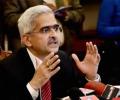
Amid prolonged uncertainty, continued policy support will be crucial for sustained economic recovery from the coronavirus pandemic, Reserve Bank Governor Shaktikanta Das said at the recent meeting of the Monetary Policy Committee. "In this period of prolonged uncertainty, it would be wise to remain agile and respond in a gradual, calibrated and well telegraphed manner to the emerging challenges," opined Das, according to the minutes of the MPC meeting released by the Reserve Bank on Thursday. Observing that economic recovery from the pandemic remains incomplete and uneven, he said, "continued support from various policies remains crucial for a sustained recovery." The governor said the renewed surge in international crude oil prices, however, requires close monitoring.

In the last policy review in December, RBI had decided to keep policy rate unchanged.

Traders will now focus on the RBI's monetary policy review next week which will be key in helping get some clarity on the central bank's thoughts on the outlook for inflation and rates.
The Reserve Bank of India on Wednesday retained the economic growth projection for the current financial year at 10.5 per cent, while cautioning that the recent surge in COVID-19 infections has created uncertainty over the economic growth recovery. In its last policy review, the RBI had projected a GDP growth rate of 10.5 pc for FY'22. Taking various factors into consideration, it said, "the projection of real GDP growth for 2021-22 is retained at 10.5 per cent consisting of 26.2 per cent in Q1, 8.3 per cent in Q2, 5.4 per cent in Q3 and 6.2 per cent in Q4."
Finance Minister P Chidambaram said, "When we return in 2014, we will be more friendly."

A panel has recommended that the RBI should bring down CPI inflation to 4 per cent.
Flush liquidity, apart from softening short-term money market rates, poses inflationary risks.

CPI inflation will remain below the target of 6 per cent set for January 2016.
In policy review meet in June, RBI Governor Raghuram Rajan kept interest rates intact.

The Reserve Bank on Friday retained the real GDP growth projection at 9.5 per cent for 2021-22 as domestic economic activity has started normalising with the ebbing of the second wave of the virus and the phased reopening of the economy. In the June monetary policy, the RBI had lowered the growth projection for 2021-22 to 9.5 per cent from 10.5 per cent estimated earlier. Unveiling the bi-monthly monetary policy, RBI Governor Shaktikanta Dad said high-frequency indicators suggest that consumption (both private and government); investment; and external demand are all on the path of regaining traction.

The decision by the Reserve Bank of India to introduce a unified regulatory framework on connected lending for all the regulated entities (RE) is expected to reduce the influence of business conglomerates in the Indian lending space, said bankers and experts. "Connected lending pertains to lending to related parties within the same business group. "While the RBI might appear more agreeable to allowing business conglomerates to own banking licenses, it deems it crucial to bolster regulations that would prevent conglomerate-owned banks from gaming the system," said Shivaji Thapliyal, head of research and lead analyst, YES Securities.

In its Fifth Bi-monthly Monetary Policy Statement, 2017-18, RBI said the second quarter growth was lower than the one that was projected in the October review, and the recent increase in oil prices may have a negative impact on margins of firms and Gross Value Added (GVA) growth.

'Choose an FD tenure that provides a balance between returns and the horizon for which you can invest.'

The six-member monetary policy committee voted 5:1 for the decision, with only Ravindra Dholakia voting for a 0.25 per cent reduction in rates.

"Finance Ministry and RBI keep talking all the time," Rajan said.

So for the time being, consumers need not worry about their EMIs on home loans, auto loans etc. going up. However, as April progresses the scenario could change.
.jpg)
Markets ended tad lower with financials declining the most ahead of RBI policy review tomorrow.

Fintech companies believe that the impact of Reserve Bank of India's order last week on unsecured loans will be visible in six to 12 months and prompt them to diversify and strengthen their secured portfolio. Fintechs which source funds through banks or non-banking finance companies (NBFCs) are looking at quickly building their secured portfolio options to at least 40 per cent of their total portfolio. "Over the medium to long term, as part of our product strategy, we are evaluating secured products which can be enabled over a digital platform" said Yogi Sadana, the founder of Zype, a lending-focussed fintech.

At interactions last week with senior officials from the Reserve Bank of India, select banks gave feedback on two key bond market concerns, namely, recent volatility in the rupee-dollar exchange rate and heavy losses incurred on floating rate government bonds due to a demand-supply mismatch, sources told Business Standard. The discussions were held ahead of the RBI's next monetary policy statement, scheduled on August 5. Indian banks are large holders of government securities because of a regulatory mandate to set aside a certain percentage of deposits in sovereign bonds.
Given the pressure from India Inc and the banking fraternity, it is surmised that the portfolio rejig will take place before April.

The Reserve Bank on Friday retained the inflation forecast for 2023-24 at 5.4 per cent, and vowed to take timely measures to prevent any spillovers of global food and fuel price shocks. Stressing that the Reserve Bank has identified high inflation as a major risk to macroeconomic stability and sustainable growth, Governor Shaktikanta Das said the September retail inflation number may be lower than August and July prints. The headline inflation based on Consumer Price Index (CPI) moderated to 4.6 per cent in first quarter of 2023-24 as compared to 7.3 per cent in the same period a year ago.

Fitch Ratings on Tuesday retained India's economic growth forecast at 7 per cent for the current fiscal, but cut projections for the next two financial years saying the country is not impervious to global developments. In its December edition of the Global Economic Outlook, Fitch projected India's GDP to grow at 7 per cent in the current fiscal, at a slower rate of 6.2 per cent in 2023-24 and at 6.9 per cent in 2024-25. In September, Fitch projected 7 per cent growth for the current fiscal, followed by 6.7 per cent in 2023-24 and 7.1 per cent growth in 2024-25.
